


Main transport costs and what measures to take to optimize them (updated July 2023)
A recent study by https://inconvenienttruck.eu/ states that there are over 13 million transport vehicles in Europe, of which about 80% are heavy-duty trucks or vehicles with a total permissible laden weight > 15t.

In this article we will look at heavy goods vehicles, as they represent, in a similar proportion, the largest sample of the Bulgarian carriers’ fleet. One of the main indicators of “success” among carriers is the mileage traveled within one calendar month or year.
In the vast majority of cases (whether they are executing import/export routes from home country or cabotage transport within Europe), the minimum mileage that a single transport unit is intended to travel in order to achieve good profitability is an approximate 10000-12000 km / month.
Of course, there are business models among carriers that travel less kilometers, but with better profitability per km. due to the value of the cargo, as well as carriers that have optimized the weekend and have an average of over 12,000 km on average.
For the ease of calculation, we will use a monthly mileage of 10000 km. per transport unit. Here are the fundamental expenses a carrier has to pay for each single kilometer driven – Energy (in the most common case – diesel fuel), toll taxes, driver’s costs, and depreciation costs (including Tires, oils, lubricants , and others.). In a brief study amongst the major manufacturers – Mercedes, Scania, Volvo, MAN, DAF, (all EURO 6), the manufacturer’s stated consumption in real tests with a load of at least 18 tons. varies between 25-29 l / 100 km. Given the different fuel prices in each country, we will take an average value to calculate the total cost.
The average price in Europe according to https://autotraveler.ru/ as of July 11, 2023. is 1.42 EUR with VAT or indicative 1.18 EUR without VAT. That is, to get around 10,000 km, we will need between 2500-2900 liters per vehicle or 2950-3422 EUR excluding VAT. In other words, an amount in the range of 0.295-0.342 EUR / km will cost you to pay the fuel for the distance traveled. In the section of toll taxes, the situation is similar, based on the analysis of various freight transport companies, Truckpoint sets an average toll rate per km. (as of July 2023) in the range of 0.15 EUR – 0.20 EUR, which of course depends on the countries where goods are most often transported, the emission class of the vehicle, the number of axles, in some cases even the weight of the load. For the purpose of the exercise, we will take a conservative value of 0.15 EUR / km excluding VAT, resulting in an additional cost of 1500 EUR to travel 10000 km / month on paid road sections.
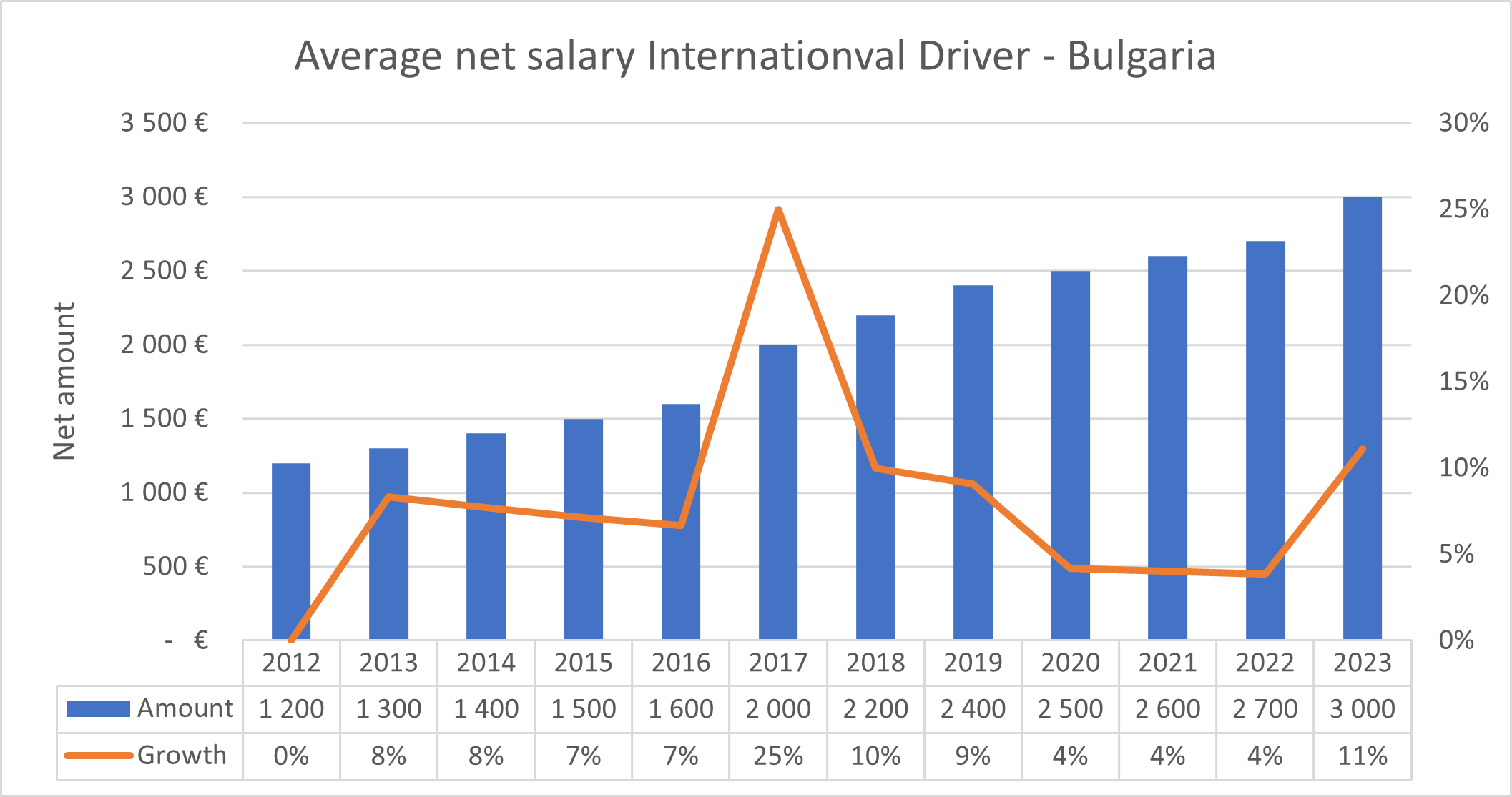
The cost of an international transport driver has grown significantly over the past few years, with lower graphs perhaps better targeting newer drivers in the industry than average drivers’ retirement expectations.
In a large aspect, wages in Bulgaria reached the levels of Western countries. This on one hand is driven by the lack of “new additions” to this category of labor, on other the strong growth of Bulgarian transport companies in recent years. Current salary range starting 2700-3000 EUR / month, for the purpose of our calculation, at 10000 km / month, this makes an approximate 0.27-0.30 EUR / km.
The expenses for other operating costs (including tires, oils, repairs) are also not negligible, as on the basis of several interviews with carriers, the amount varies between 0.05 EUR / km.
Of course, this depends on a lot of things, initially made investments in better quality products and other non-carrier-dependent circumstances. In other words, this cost item will cost you roughly € 500 to travel 10000 km in one month.
To summarize what we have written here, we will add an approximate monthly lease payment (depending on the initial installment) of a EURO 6 truck to the standard terms of each of the leading manufacturers. Let us use a table to sum up the above mentioned operational costs by sticking to the more conservative options, namely
| Component | Total for 10000 km in € | Cost per km. in € | Percent |
|---|---|---|---|
| Fuel | 2950 | 0.295 | 32% |
| Toll taxes | 1500 | 0.150 | 16% |
| Driver net salary | 2700 | 0.270 | 30% |
| Operational (Tires, lubes, etc.) | 500 | 0.050 | 5% |
| Depreciation (Truck + Trailer) | 1500 | 0.150 | 16% |
| Total | 9150 | 0.915 | 100% |
In addition, carriers also have other costs, such as vehicle investment costs, insurances, Carrier’s liability, Casco and cargo insurance, the last two are not mandatory but highly recommended to avoid further complications with the business.
The cost of the already outlined expenses is certainly influenced by many economic factors and the more important information we need to get out is the following:
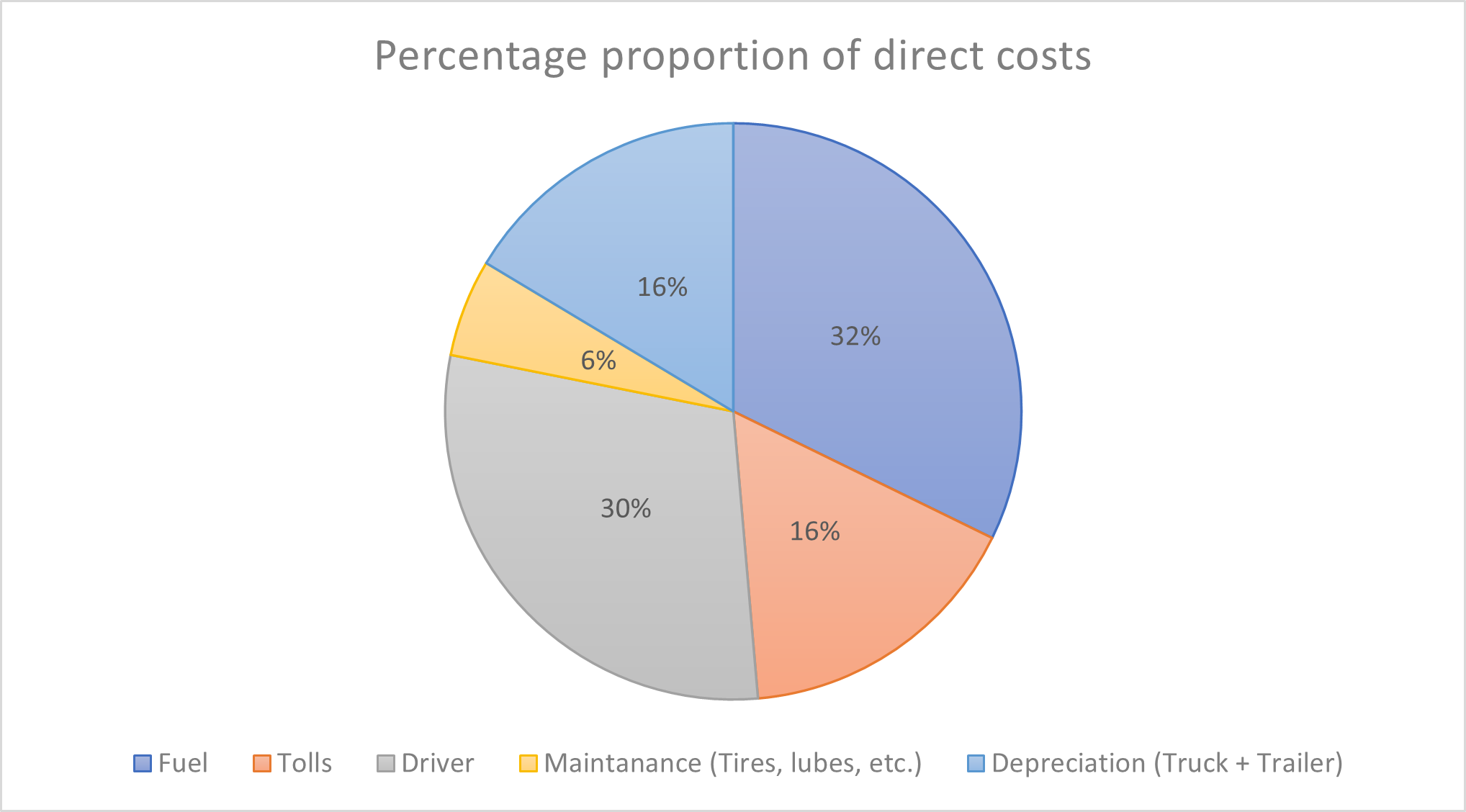
Fuel and tolls account for 50% of the total operating costs, and given that driver spending cannot be optimized, especially if we want to set high quality staff, Truckpoint’s team advises to focus on reducing the first two components , namely the cost of Energy and the value of the paid road sections.
Of course, the proposed calculations are based on averages, and the different carriers in various countries may have deviations from the values and percentages given. It is a fact that fuels and tolls are a major resource that can be optimized by applying the right measures.
Cost optimization tips for tolls and fuels:
- Try to load in countries where the price per liter of diesel is relatively low in the region. In particular, if we take Benelux as an example, it is good to load in Luxembourg instead of the Netherlands. In addition, gather information for fuel price (excluding VAT and Excise Duty) up-to-date, as each country in the EU allows refunds of VAT charged on fuel, and a number of countries also allow part of the excise duty to be refunded. In this case, Belgium may be more attractive even from Luxembourg as a point of loading on certain days.
- Uplift fuels from leading distributors, as product quality helps lower energy consumption. Try to avoid cases where you are charging fuels with an unclear source or no quality guarantee.
- Minimize “empty” kilometers by selecting sites that are in more accessible locations. In many cases, drivers are tempted to load into smaller, lower-priced sites, but they cost them time, mileage spent in excess, and in some cases even fines for use on forbidden road sections. One hour of driving is more valuable than an hour spent fueling, as at an average speed of 80 km/h you will be able to drive 80 km. Using more accessible objects will also help you avoid unpleasant delays, which may also cost carriers money.
- Pay road sections by way of on-board devices or other means that are tied to your company account. The possibility of posting an expense without an invoice is extremely difficult, and in addition the refund of VAT is almost impossible.
